

Removing unwanted tattoos is now more possible than ever before. At Chelsea Cosmetics, we use the latest generation of laser technology with the Picosure Picosecond laser and the Fotona QS (QX MAX). These machines offer advanced, non-invasive treatments that can remove most tattoo colours in fewer sessions than conventional lasers, with less discomfort.
Laser tattoo removal uses high-intensity light beams to break down the ink particles in the tattooed skin.
During the procedure, a laser emits short pulses of light that penetrate the skin and are selectively absorbed by the tattoo ink. The light energy causes the ink particles to fragment into smaller pieces, which are then gradually absorbed and eliminated by the body’s lymphatic system.
Today’s technology requires fewer sessions than previous lasers; however, multiple sessions may still be needed, depending on the size, colour and age of the tattoo.
Most individuals tolerate the treatment well; however, you may experience some discomfort. After the treatment, there may be temporary redness, swelling, or blistering, but these side effects resolve over time.
DISCLAIMER: Certain lightly pigmented colours, such as yellow and light hues, may not respond as effectively to the treatment as darker colours. This makes their removal more challenging and may require additional sessions.
Our machines
The fotona qx max
The QX MAX is the most advanced Q-Switched laser on the market today. Featuring four wavelengths, it can remove a broad spectrum of tattoo colours, target larger spot sizes and deeper-lying pigments, enabling treatment of even the most complex multicoloured tattoos. The QX MAX is built for maximum performance, featuring patented, state-of-the-art innovations that make treatments safer and more effective.
Common side effects: Frosting (a temporary white colour change on the skin surface immediately after treatment), redness, swelling, blistering and crusting, pain, and pinpoint haemorrhaging are common and typically resolve in 3 to 14 days.
Rare side effects and long-term complications: Although this laser is considered generally safe and effective due to its advanced pulse technology, which reduces tissue damage, rare side effects include infection, hypopigmentation, hyperpigmentation, and minimal scarring (in less than 2% of cases). Allergic reactions and textual changes are also possible. Infection can occur if the area is not kept clean, with symptoms including prolonged swelling or pus.
Suitability: Suitable for all skin types, including darker skin tones. However, an initial consultation is necessary to assess your skin type, tattoo and medical history.
The PicoSure picosecond laser
The Picosure Picosecond laser is the world’s most advanced skin laser. It uses advanced, ultrashort picosecond pulses to shatter ink into tiny, easily removed particles. Treatments are faster and more effective, requiring fewer sessions than traditional lasers for tattoo removal. The Picosure laser is highly effective for black ink, stubborn colours and recalcitrant tattoos.
Common side effects: Mild blistering, redness, pinpoint bleeding and swelling are common. The symptoms typically resolve within a week. Some patients may experience pigment changes (hypopigmentation or hyperpigmentation).
Rare side effects: Scarring.
Suitability: The Picosure laser is suitable for most skin types. However, an initial consultation is necessary to assess your skin type, tattoo and medical history.
Put your trust in experienced professionals
One of the most critical factors in deciding which Melbourne cosmetic clinic to visit is trust. Trust is best formed when you know you are in the hands of highly trained, highly skilled and experienced professionals, such as the team at Chelsea Cosmetics. We pride ourselves on attention to detail. But most importantly, we listen to you. Our policy is take into account and respect all concerns you may have. This ensures we give you an unbiased recommendation with your best interests as our top priority.
Request a Consultation
Laser Tattoo Removal Melbourne Gallery
Browse our before & after images of procedures performed by Dr Mark Attalla in Melbourne, Australia
The outcomes shown are only relevant for this patient and do not necessarily reflect the results other patients may experience, as results may vary due to many factors, including the individual's genetics, diet and exercise.
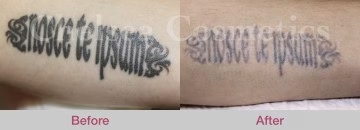
Is laser tattoo removal suitable for you?
At Chelsea Cosmetics, medical-grade lasers are used for tattoo removal treatments. Suitability for treatment is assessed during a consultation, where individual factors such as tattoo size, colour, and skin type are considered.
Disclaimer: Certain lightly pigmented colours like yellow and light hues may not respond as effectively to the treatment. This can make their removal more challenging
During your free initial consultation, we’ll provide a thorough assessment of your eligibility and estimate the number of sessions required. The practitioner will also discuss what to expect from the procedure. This way, they can make sure you understand your recovery time and the likely results.
Our Approach
At Chelsea Cosmetics, we provide a range of surgical and non-surgical cosmetic procedures. When choosing a clinic, patients can consider the qualifications and registration of those providing the treatments.
We are committed to listening to patients, taking their concerns into account, and providing information so that decisions can be made with realistic expectations and an understanding of potential risks and outcomes.
Your Laser Tattoo Removal Treatment Consultation at Chelsea Cosmetics
The first step in determining whether laser tattoo removal is suitable for you is to book a free initial consultation. During this time, we can assess your tattoo, taking into account factors such as the tattoo’s size, colour, and your skin type. We’ll also listen to your objectives and answer any questions you have.
After thoroughly assessing you, we can determine your eligibility and provide an estimate of the number of sessions required.
Our practitioner will also carefully explain what you can expect from the procedure, including the procedure itself, after-care, recovery time and results. This way, you’ll be equipped to make an informed decision on whether you’d like to proceed with laser treatment.
Request ConsultationRecovery information
Recovery and beyond
When undergoing the procedure, it is important to properly care for the treated area. Here are some post-treatment instructions to help with recovery:
Rest and give the area some time to recover.
Use cool packs or soothing gel to ease discomfort and reduce swelling
Refrain from excessive scrubbing or shaving.
Avoid picking or scratching any crusts to prevent infection or scarring.
Gently wash the area daily without scrubbing.
After 24 hours, apply a paraffin-based product to moisturise crusty areas.
Until redness and crusting subside, steer clear of scented lotions, soaps, or creams with AHAs.
Stay away from chlorinated pools or spas until the area has healed completely.
Satisfying results
* Results will vary for each person, and all surgical, invasive or clinical procedures carry risks (even if they are rare).A thorough consultation is required prior to each treatment to determine if it is suitable for the patient.
COMMON QUESTIONS
Frequently asked questions
At Chelsea Cosmetics, we use various modalities to make your tattoo removal treatment as comfortable as possible. The laser treatment itself is best described as being flicked with a hot elastic band. To counteract these sensations, we will apply a topical numbing cream to your treatment area a good 30 to 60 minutes beforehand. While the treatment is in progress, we’ll also use cooling machines to further alleviate any heat and discomfort.
Most treatments last only a few minutes, though, and patients usually tolerate them well.
During a laser treatment, the laser doesn’t penetrate the skin’s surface, significantly reducing the risk of scarring. Therefore, scarring from laser tattoo removal treatment is rare. Instead, the laser targets and breaks down ink particles beneath the skin, which are then flushed away by your lymphatic system. However, you must take good care of your treated area while it is healing. To help ensure the best outcome, avoid sun exposure, allow sufficient time between sessions for optimal healing and keep the skin hydrated.
Once your tattoo treatments are complete, the area has healed, and the tattoo is sufficiently faded, you can certainly get a new tattoo in the treated area.
The number of sessions required to remove your tattoo depends on various factors. For example, the size, intensity, colour, location, complexity and age of the tattoo are all contributing factors. Specific individual factors, such as your general health and skin type, will also help determine how many sessions you will need.
Typically, it takes 2 to 4 sessions to lighten a tattoo for a cover-up and 8 to 10 sessions for removal. Changes will appear gradually, and further treatments may be considered to continue the process.
Before you proceed with treatment, you’ll have an initial consultation where we will assess you and your tattoo closely and provide you with an estimate.
Our Picosure and Fotona QS (QX max) lasers, when used appropriately, can effectively remove most tattoo colours. Depending on the tattoo, we may use both lasers to target all pigments. For example, when targeting a broader range of colours, including blues and greens, we use the Picosure laser, which is designed to break down these stubborn pigments.
However, please note that some colours are more challenging to treat than others. Yellow ink is difficult to treat, for example, as it is too light to absorb the laser’s energy.
After your initial consultation, we’ll give you pre-treatment instructions to follow closely. However, you may want to keep the following instructions in mind.
Sun exposure: Avoid sun exposure for 2 weeks before treatment. If your skin is excessively sun-tanned, we cannot laser it. Keep in mind that sunburn requires a month to recover before laser tattoo removal treatment.
Medications: Contact us if you change your medications. Various medications (for example, retinoids, antibiotics and Roaccutane) can affect your skin by increasing photosensitivity, which may cause blistering.
Health: Stay hydrated and healthy. As the ink removal process requires a good immune system, it pays to look after yourself during this time. Drink plenty of water, exercise regularly, eat a healthy diet and moisturise your skin.
For the best result from your tattoo removal, it pays to have a fit, healthy body. During treatment, the laser breaks down ink particles into smaller pieces. These pieces need to be removed by your body’s white blood cells through the lymphatic system. Regular exercise boosts blood and lymphatic flow, helping your body clear the ink more efficiently.
However, you must not rush the tattoo removal process. You’ll need plenty of time in between treatments for your body to break down the ink. What’s more, you’ll need to keep your skin healthy. Stay hydrated, moisturise regularly and protect the treated area with SPF 50+ so that your skin remains strong and in the best position to heal.
Avoid wearing tight-fitting clothing over the treated area as this can irritate the delicate, healing skin.
Finally, follow all our post-treatment recovery instructions carefully and always contact us if you have any concerns.
IMMEDIATELY AFTER TREATMENT: Your tattoo may appear darker immediately after treatment. This is due to bruising. Once complete healing has occurred, though, the tattoo will noticeably lighten. You’ll notice that shading drops out first and can disappear as early as 1 to 2 sessions.
MID-WAY THROUGH TREATMENT: Denser, thicker lines can take longer to fade. You may start to notice the ink becoming dull or fading to a brownish colour. Ink won’t fade evenly, though, so don’t be surprised if the tattoo appears patchy or uneven halfway through your treatment plan. Be patient and understand that it may take several months for your tattoo to fade.
END OF TREATMENT: Towards the end of your treatment, your tattoo will likely appear like a light shadow of ink, a bit like veins that sit underneath your skin.
Avoid chlorinated pools, the beach and saunas until your treated area is completely healed.
Patients are typically asked to wait 6 to 8 weeks between treatments so that the skin can fully heal and the body can flush out all the ink particles. Sometimes, if the tattoo is being treated and broken down into smaller sections, this time may be reduced to 4 weeks.
It’s best to wait 6 to 8 weeks for your skin to heal before we fully commence the removal process.
The fingers, feet, head, and rib cage are among the most painful areas during tattoo removal, as they are close to the bone. Conversely, the least painful areas for tattoo removal are the thighs and upper arms.
Potential risks & complications
Risks and complications associated with laser tattoo removal include:
- Redness
- Swelling
- Blistering
- Changes in skin texture
- Scarring
- Infection
- Hyperpigmentation (darkening of the treated area)
- Hypopigmentation (lightening of the treated area)
- Residual ink or incomplete removal
- Pain or discomfort during and after the procedure
Contact us to schedule your consultation.
Before deciding on cosmetic surgery, it’s important to have realistic expectations about the outcome. Talk to your cosmetic doctor about what to expect from the surgery and make sure you understand the recovery time and results.